Billion dollar green business

50% off electronics’ greenhouse gases, the world’s largest tidal plant, and a hydrogen fuel cell that powers 3000 homes are just some of the impressive Korean green business initiatives.

The first, Samsung has just announced over 4 billion dollars of investment to green its electronics. It will cut the greenhouse gas embodied in its products by 50%. Once past the factory gate goods also use power and, Samsung says, its TVs, refrigerators and air conditioners will be the most efficient (lowest power use) products available.

Efficiency is also central to the stationary hydrogen fuel cell. The plant producing heat & electricity for 3000 homes does so by using 80% of the available energy from gas for a current cost of about AUD 0.23 per unit.

And the world’s largest tidal power plant – it will deliver power at approximately half the cost of wind power. Hydrogen and tidal power plant pictures and detail are here. Cost comparisons here.

Business action

Over a third of Australian businesses are already taking action to cut greenhouse emissions and reduce energy use according to a recent Australian Industry Group and KPMG survey. The report finds nearly 70% of businesses – from a random sample across construction, service and manufacturing industries – are currently acting or plan to act to manage carbon footprints.

For any company there are many reasons to address climate change. Increasingly major companies will demand a supplier understands its carbon footprint. The international Carbon Disclosure Project reports this is already occurring with Cadbury, Colgate-Palmolive, Johnson & Johnson, P&G, Unilever, Vodafone (1) and Walmart (2) among the companies asking suppliers to report on carbon footprint and climate change strategies.

The Carbon Disclosure Project represents Investors with assets of $55 trillion. Its just one of the major reasons why, across the world, companies are looking to find carbon advantages.
The picture shows a stationary hydrogen fuel cell power plant in Seoul, Korea.

1 million green jobs

As governments around the world move to implement green stimulus packages a standout initiatives is in Korea.

The country is spending $38.5 billion on clean technology and environmental restoration. The Korean Presidential Committee on Green Growth says it will deliver 956,000 new green jobs. The four year package is about 2.6% of Korea’s yearly gross domestic product (GDP). Funding goes to rivers, forests, clean transport and bikeways and, green homes and neighbourhoods.

At the same time this strategy is driving private investment. JP Morgan has just announced that it is raising $1 billion to invest in Korean solar, LEDs (high efficiency lighting) and green cars.

Picture: Back to A future, the restoration of Cheong gye cheon. 5.8kms of freeway back to a river.

Network City – Giving Back to China’s Environment

China is growing and urbanising at an extraordinary rate. With its economic growth there is increased environmental pressure. Among the initiatives to change this – have growth while giving back to the environment – is the Network City by Brearley Architects with GreenMode. Its initiatives include:

  • Green roofs and walls plus light coloured hard surfaces and/or vegetation across roads – increasing amenity, cutting heat and consequently power use.
  • Building energy efficiency through the use of green roofs and walls as well as solar hot water, efficient lighting and high efficiency appliances.
  • The network city integrates commercial and industrial uses throughout its residential, agricultural and recreational areas. This reduces the demand for motorised private transport.
  • Throughout the city food production is integrated into the street plantings, arbours, parks and gardens plus, roof spaces and walls. The net impact of creating edible landscapes is to reduce the city’s food footprint.

The improvement is illustrated by comparing it to a standard city of 45,000 people. The reductions, such as halving people’s power and home footprints, are illustrated in the figure above.

Point and power

Its a well known and obvious fact that when a surface faces the sun it is exposed to more light. Tracking the sun with a solar panel gives you up to 35% or more power over a similar sized fixed installation. But the motors to make this happen impose extra costs.

In the natural world, plants have evolved to follow the sun. So could we artificially mimic a sunflower and use this to point solar panels at the sun? MIT has demonstrated just such a system using a curved arch made from two different metals. Simple systems like this should be cheap and the techniques, known as biomimicry, have many applications beyond just tracking the sun.

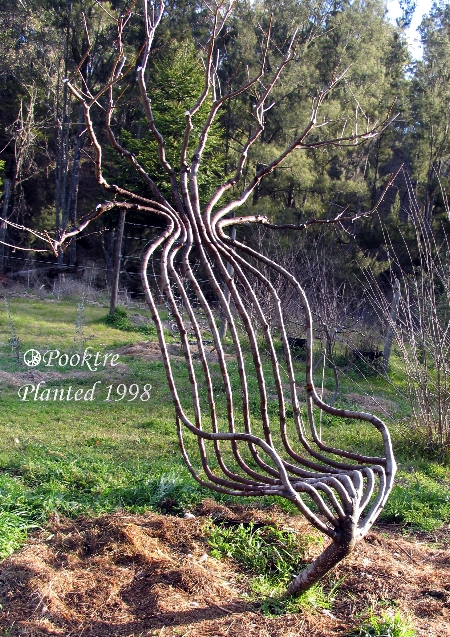
But brining the natural world into today’s society is not just about hi tech applications. The picture illustrates living furniture, grow your own garden settings, certainly unique!

The race to lead

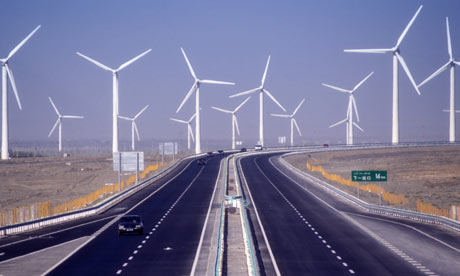
Traditional perspectives about renewable energy are increasingly being challenged. China’s wind and solar growth is one example. Zhang Xiaoqiang, vice-chairman of China’s national development and reform commission, talking to the UK Guardian sees 100GW of wind power coming from China by 2020.

That’s 50 to 100 coal fired power plants worth of electricity. On top of this solar electricity is set to expand 75 fold. Cummulatively he sees renewables providing close to 20% of China’s power in 2020.

In 2008 China ranked second behind the USA for wind power growth. It’s been doubling every year for the last four years. With nearly 38% of China’s financial crisis stimulus package being spent on green initiatives, western countries will be challenged for clean technology development leadership.

White is the new green

Image first on http://www.huffingtonpost.com/a-siegel/energy-cool-white-roofing_b_128545.htmlWhite roofs and surfaces could be worth a staggering $1,100 billion according to recent research.

Nobel prize winner Steven Chu, Obama’s Energy Secretary, is promoting this change. Chu says just changing the colour of roofs and blacktopped freeways and streets is equivalent to taking all of the automobiles in the world of the road for eleven years.

White reflects heat and a worldwide change would help cool the world. As a bonus, light surfaces can help reduce the cost of cooling buildings which reduces emissions. However, Hashem Akbari, the lead scientist behind some of this research is careful to point out that converting to cool urban surfaces does not address the underlying problem of global warming.

These impressive numbers from white roads and roofs are not the only option. Living green roofs and walls can drop temperatures (and associated air conditioning costs) by as much as eleven degrees.

Winds of Change

In just eleven years, since 1997, the proportion of the world’s electricity generated from wind has almost quadrupled. There are some impressive absolute numbers behind this global proportion.

In 2008 Australia’s total capacity increasing by over 50%, China doubled its total installed wind power and growth was 50% in the USA.

With this impressive growth comes an equally impressive challenge. Coal still provides over 40% of the world’s power. While wind is growing at 29% a year, versus coal’s 4.5%, in absolute terms coal still dominates over wind. The International Energy Agency wedges illustrate the challenge.

Big Solar for Oz

10MW Solar Tower - wiki media commonsThe 2009 Australian budget delivers 1.4 billion dollars – over 6 years – for solar power. So how much solar electricity will Australia get?

The government subsidy is for new solar plants that together produce a coal plant’s worth of power – up to 1000MW. Abengoa Solar, a leading solar power company currently constructing solar plants worldwide, put the cost of a 300MW plant at 1.2 billion euros in 2007. In 2009, the Arizona state government announced a 200MW plant for 1 billion US dollars.

The actual cost and reliability of the power generated is as important as the government subsidy for construction costs. The U.S. National Renewable Energy Laboratory estimates, for solar plants generating power 24 hours a day by storing the sun’s heat, electricity will soon cost about US 13 cents a unit.

On this scale, sun power is starting to become competitive with expected future power prices.

Three into One

Can you fit three houses into one without compromising amenity? If you can then the environmental impact of a home would be cut – significantly!

Click for larger Housing Ecological Footprint imageRecent work by Lend Lease (through Delfin Lend Lease) with the Queensland EPA and GreenMode shows how it can be done. The results, appearing in the Queensland Government’s Smart and Sustainable Homes newsletter, are for 35 different homes of the types typically constructed in South East Queensland.

By implementing simple measures – such as insulation, orientation, high efficiency cooling and heating, and window shading – the Ecological Footprint of a home with people living in it is cut by a factor of five.

When construction and the physical maintenance of the house are also included, three of these sustainable homes could fit in the footprint of one ‘standard’ house (of the type commonly constructed in Queensland).